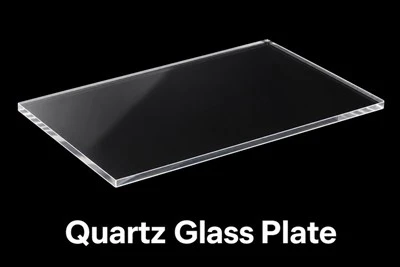
The production of quartz glass sheets primarily involves four core stages: raw material preparation, high-temperature melting, forming and annealing, and precision machining. The mainstream manufacturing routes are categorized into melting natural materials and chemical synthesis.
Core Manufacturing Process
Raw Material Pre-treatment
High-purity quartz sand (purity ≥99.99%), natural crystal, or silicon-bearing compounds (such as silicon tetrachloride) are selected. They undergo crushing, screening, wet ball milling, impurity removal, and drying to yield suitable raw materials.
High-Temperature Melting
The raw materials are heated to over 1,700°C until completely molten. Heat sources vary by process: the electric melting method uses electric heating; the gas melting method employs an oxy-hydrogen flame; and the synthetic method generates high-purity silicon dioxide via vapor-phase deposition reactions.
Forming and Annealing
The molten quartz glass is shaped into a blank (preform) through drawing or pressing. It is then slowly cooled to relieve internal stress and prevent subsequent cracking.
Precision Machining into Sheets
The glass blank undergoes a sequence of processes-water-jet cutting for profiling, diamond milling for shaping, grinding for thickness control, and polishing for surface finishing-to ultimately produce quartz glass sheets that meet precision specifications.