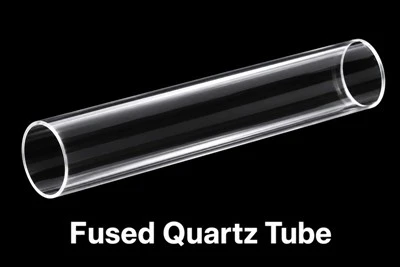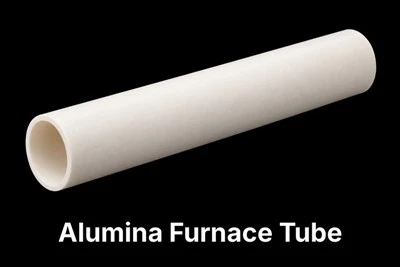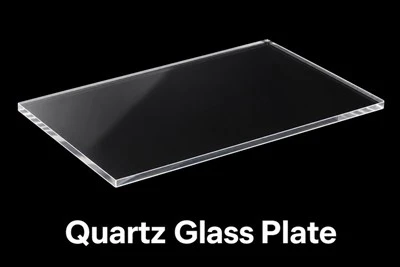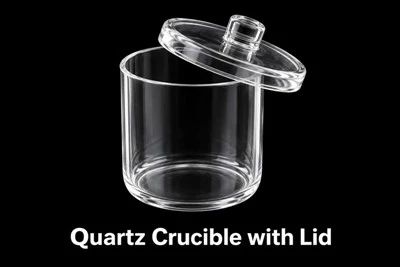
Quartz glass pieces are specialized industrial materials made from high-purity silicon dioxide. Their core functions span several critical areas, including high-temperature resistance, optical transmission, and corrosion resistance, as detailed below:
1. High-Temperature Resistance and Thermal Stability
With a softening point of approximately 1730°C, the material remains stable during long-term use at 1100°C and can withstand peak temperatures of up to 1450°C for short periods. Its extremely low thermal expansion coefficient allows it to withstand direct quenching from 1100°C into room-temperature water without shattering, making it suitable for various high-temperature operating environments.
2. Full-Spectrum Optical Transmission
It offers a transmission range extending from ultraviolet to near-infrared wavelengths, with visible light transmission exceeding 93%. Classified by spectral characteristics into three types-JGS1 (far-ultraviolet), JGS2 (ultraviolet), and JGS3 (infrared)-it serves as a core optical component in UV lithography, laser systems, and precision optical instruments.
3. Strong Corrosion Resistance and Chemical Stability
Except for hydrofluoric acid, it is virtually inert to other acids and alkalis. Its acid resistance is 30 times that of ceramics and 150 times that of stainless steel; it maintains stable performance even in high-temperature, corrosive environments, making it ideal for demanding applications in the chemical and semiconductor industries.
4. Excellent Electrical Insulation
With an electrical resistance ten thousand times higher than that of ordinary glass, it is a superior electrical insulating material. It maintains stable insulation performance even at high temperatures, ensuring the operational safety of electronic and power-related equipment.